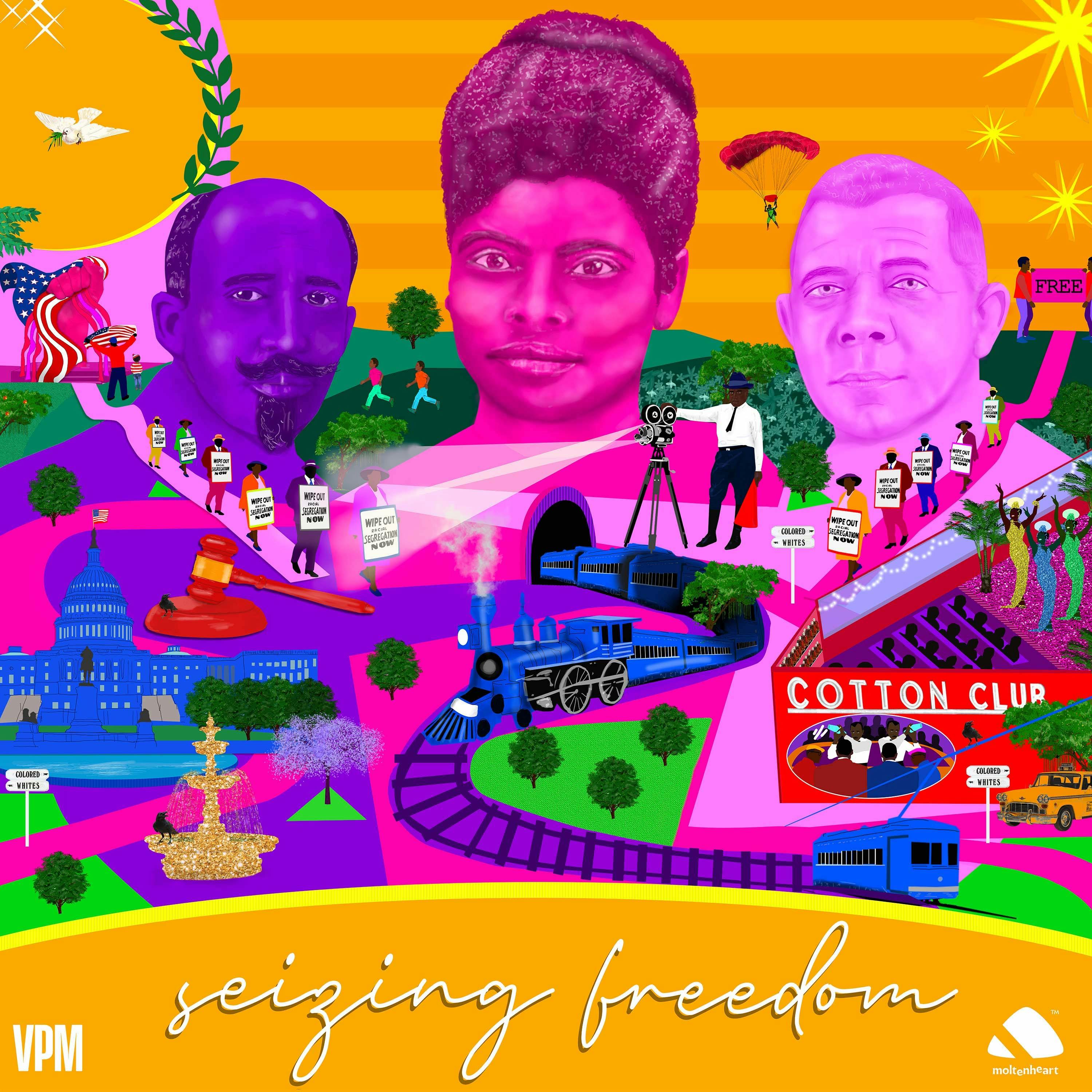
Seizing Freedom
VPM·40 episodes·Weekly·No new episodes since May 2022
Quick Facts
Highlighting true stories of Black people’s fight for liberation, progress and joy from the Civil War to the Civil Rights Movement and beyond. Seizing Freedom illustrates the myriad ways Black people have sought and defined their own freedom in spite of the monumental forces at work to keep them from it.
Episodes
Latest Episode
May 17, 2022 · 41m
Season 2 Finale. Kidada speaks with activist and organizer Mariame Kaba about the ways many of us practice abolition without realizing it, how ordinary people have the power to collectively free themselves, and why safety can only be found through community. They discuss how the prison industrial complex and the systems it encompasses do more harm than good and identify solutions that address the underlying causes of criminalized activity and provide the resources and support needed for everyone to thrive. Additionally, they touch on the power of public libraries to offer a safe haven for all, as well as cultivating a practice of hope to navigate difficult circumstances. --- Episode Artwork by Lyne Lucien. Transcripts, resources, list of voice talent and more --- This episode of Seizing Freedom is supported by Home. Made., a podcast that explores the meaning of home and what it can teach us about ourselves and each other. Listen to episodes of Home. Made. at
More Episodes
May 10, 2022 · 51m
African Americans couldn’t seize much universal freedom as the brick-and-mortar of Jim Crow walled them off from their rights. Still, race men and women fought. Following the death of three friends, instigated by the white press, Ida B. Wells committed herself to investigating and reporting the evils of lynching across the south, starting a newspaper in Memphis, Tennessee. It wasn’t long before her printing press was burned to the ground and she was forced to relocate to Chicago. The windy city was witnessing the rise of Black Hollywood, inspiring race leaders like Wells and film producer Oscar Micheaux to harness the power of media to challenge the narratives being reinforced by racist newspaper reports and deeply problematic films like Birth of a Nation. --- Episode Artwork by Lyne Lucien. Transcripts, resources, list of voice talent and more available at seizingfreedom.com. --- This episode of Seizing Freedom is supported by Home. Made., a podcast that explores the meaning of home and what it can teach us about ourselves and each other. Listen to episodes of Home. Made. at https://link.chtbl.com/homemade?sid=podcast.seizingfreedom
May 3, 2022 · 34m
Kidada speaks with health reporter Julia Craven about health and wellness for African Americans, both historically and in the context of the COVID-19 pandemic. They explore how health outcomes are influenced by systemic forces and not purely the result of the personal decisions people make on a daily basis, as well as the responsibilities of individuals to make an impact within the larger framework of public health. They also touch on the relationship between capitalism and mental health, and how that is a contributing factor to the recent Great Resignation. --- Episode Artwork by Lyne Lucien. Transcripts, resources, list of voice talent and more available at seizingfreedom.com. --- This episode of Seizing Freedom is supported by Home. Made., a podcast that explores the meaning of home and what it can teach us about ourselves and each other. Listen to episodes of Home. Made. at https://link.chtbl.com/homemade?sid=podcast.seizingfreedom
Apr 26, 2022 · 48m
Attendees of the 1914 “Fifty Years of Negro Health Improvement in Preparation for Efficiency” conference, with speakers including Booker T. Washington, heard staggering information about the Black population’s “health”, which was in crisis. Life expectancy for African Americans at the time was about 35 years. African Americans rallied public health professionals to confront disease. They understood how poor health outcomes endangered their collective destiny and compromised their ability to fight for full equality. They knew that illness, disease, and lack of means and systems to treat them compromised freedom. Clean communities could improve living conditions. But clean living couldn’t undo the harm or violence of the Jim Crow era that was gradually becoming systematized in law and society. --- Episode Artwork by Lyne Lucien. Transcripts, resources, list of voice talent and more available at seizingfreedom.com. --- This episode of Seizing Freedom is supported by Home. Made., a podcast that explores the meaning of home and what it can teach us about ourselves and each other. Listen to episodes of Home. Made. at https://link.chtbl.com/homemade?sid=podcast.seizingfreedom
Apr 19, 2022 · 36m
Kidada speaks with writer, poet and social commentator Saeed Jones about the many facets of Black masculinity, how it has been shaped and reshaped over the years, and the challenges that have arisen around cultural expectations for the type of Black man you should be in order to be a credit to the race. They dig into the role of white supremacy in establishing and upholding these cultural norms and discuss how the system is operating and iterating and wreaking havoc even without active involvement from white people. They also discuss “doing the work” of dismantling harmful ideas about gender and masculinity, the relationship between safety and freedom, cultivating freedom by helping to liberate others, and finding joy by transforming pain into love. --- Episode Artwork by Lyne Lucien. Transcripts, resources, list of voice talent and more available at seizingfreedom.com. --- This episode of Seizing Freedom is supported by Home. Made., a podcast that explores the meaning of home and what it can teach us about ourselves and each other. Listen to episodes of Home. Made. at https://link.chtbl.com/homemade?sid=podcast.seizingfreedom
Apr 12, 2022 · 37m
Black workers were expected to take on “respectable” employment in the early twentieth century, essentially a racist dog whistle to keep them in the dirtiest, most dangerous and low-paying jobs. While some Black people had the means to reject these types of jobs, most couldn’t afford to. But power was there to be seized if you were willing to break the rules of respectability. In the “Negro metropolis” of Harlem, a complicated world developed in the shadows, one where Black men played by a different set of rules to claim freedom no matter the cost. Whether by reform or by violence, though, there were also those determined to keep these race rebels at bay. --- Episode Artwork by Lyne Lucien. Transcripts, resources, list of voice talent and more available at seizingfreedom.com. --- This episode of Seizing Freedom is supported by Home. Made., a podcast that explores the meaning of home and what it can teach us about ourselves and each other. Listen to episodes of Home. Made. at https://link.chtbl.com/homemade?sid=podcast.seizingfreedom