A sixth grader can tell you about the plumed hat. She has seen the photograph: the uniform, the sash, the open car moving through Harlem while the crowd presses in.
She can tell you Garvey built a shipping line and that the government came for him. She has met the monument.
She has not met the man. Children usually receive our great figures already finished, already carved, already at the summit with the speech in hand.
The photograph gets shown. The years get skipped.
A child looks up at that and draws the obvious conclusion: those people were born that way, and I was not. But I wanted our children to meet the boy who would become the leader of the largest mass movement of “Africans at home and abroad.” The Story of Marcus Garvey begins in St.
Ann’s Bay with a boy who loves to read, and it does not skip what happens to him. He leaves school early and goes to Kingston to set type by hand.
By nineteen, he is the youngest master printer in Kingston. But then, the 1907 earthquake wrecks the city.
His mother dies, and he is heartbroken. He grieves for months.
Then he picks himself up, joins the National Club, wins speech contests, and starts a newspaper he names The Watchman after George William Gordon, one of the heroes of the Morant Bay Rebellion. By his early twenties, he is known in Kingston as a printer, a speaker, and a journalist.
Marcus has a bright future ahead of him. Then, everything falls apart again.
The printers go on strike. Marcus is on the management side and joins the workers anyway, because he judges their cause to be just.
The strike runs for weeks. The union treasurer runs off with the funds.
The strike breaks. Management fires him, calls him a troublemaker, and passes the word that no one should hire him.
He cannot get work anywhere in Kingston. He takes a temporary job with the government printers and keeps going.
I want children to go with Marcus on the ups and downs of his life. A young man does the right thing, gets robbed by his own side, loses the job, and gets his name spoiled in his own trade.
Nothing about that week felt like destiny. He was twenty-two and couldn’t find a job anywhere.
Watch what his mind does next, because this is the part I most want young readers to see. He does not quit printing.
He takes the trade to Costa Rica and Panama, and he uses it to document what the banana companies do to Black workers. The skill he learned in the shop becomes the instrument he uses on the road.
Then London, where he works with Dusé Mohamed Ali at the African Times and Orient Review and reads African history among people arguing about Egypt, India, and empire. Every obstacle in that sequence gets converted into a stepping stone.
The same mind is at work when the movement is at its height. He buys a ship for the Black Star Line and renames it after Frederick Douglass, because he holds that the ancestors who paved the way should be honored, and because he understands what a name on a hull teaches the people watching from the pier.
Then the hardest years. In 1923, he is tried for mail fraud.
He cross-examines the government’s own witness and gets him to admit on the stand that the prosecutor told him to lie. The judge lets the testimony stand and refuses a new trial.
The prosecution’s key piece of evidence turns out to be an empty envelope with a Black Star Line stamp on it. He is convicted on that.
It looked, at the time, like his enemies had won. A US Marshal escorting him said, “We have captured the tiger.” Marcus answered, “But my cubs are running wild!” He was on his way to the Atlanta Federal Penitentiary when he said it.
From inside, he petitioned Coolidge, wrote to his followers, and kept the movement’s thinking alive on paper. President Coolidge commuted his sentence on one condition.
He must go back home to Jamaica. He built again in Jamaica.
He built again in London. In 1940, a journalist he knew published his obituary before he was dead, and reading it is what killed him.
That is the whole record, and children can hold all of it. Give them the triumphs and tragedies in the order they happened, and they learn the thing no highlight reel teaches: how a person with a purpose can survive any circumstance.
Garvey said it himself, in African Fundamentalism, printed in the Negro World on 6 June 1925: “God and Nature first made us what we are, and then out of our own creative genius we make ourselves what we want to be.” Read that with a twelve-year-old. Something was given.
Something is still being made. The making happens in the bad years too.
Here is what to do with the book when it reaches your house or your classroom. Read the strike chapter.
Stop at the sentence where nobody in Kingston will hire him. Ask the child what they would have done that week.
Let them answer out loud. Then read what he actually did and ask them what he was thinking when he chose it.
Do the same at the empty envelope. Do the same at the marshal’s car.
Every one of those stops puts the child inside his thinking at the moment it counted. The record matters more now than it did when I started this book.
A machine can answer almost any question a child asks in under a second. It cannot decide what is true.
It cannot choose what to become. It cannot judge a hard situation and pick the next move.
The child who reads closely, weighs evidence, and knows who they are walks into the age of AI holding the one set of skills that does not get automated. Garvey’s life is a case study in exactly those skills, run under pressure, on the record, with the failures left in.
Which is why I left the failures in the draft too. In the video with this letter, I am holding the 2012 manuscript.
Typos and all. Perseverance is one of the three things this book teaches, along with the power of the mind and the importance of purpose, and I was not going to teach it with a clean page.
Fourteen years ago, this story sat in my hands as a stack of pages I could not get right. Today it can sit in the hands of a child.
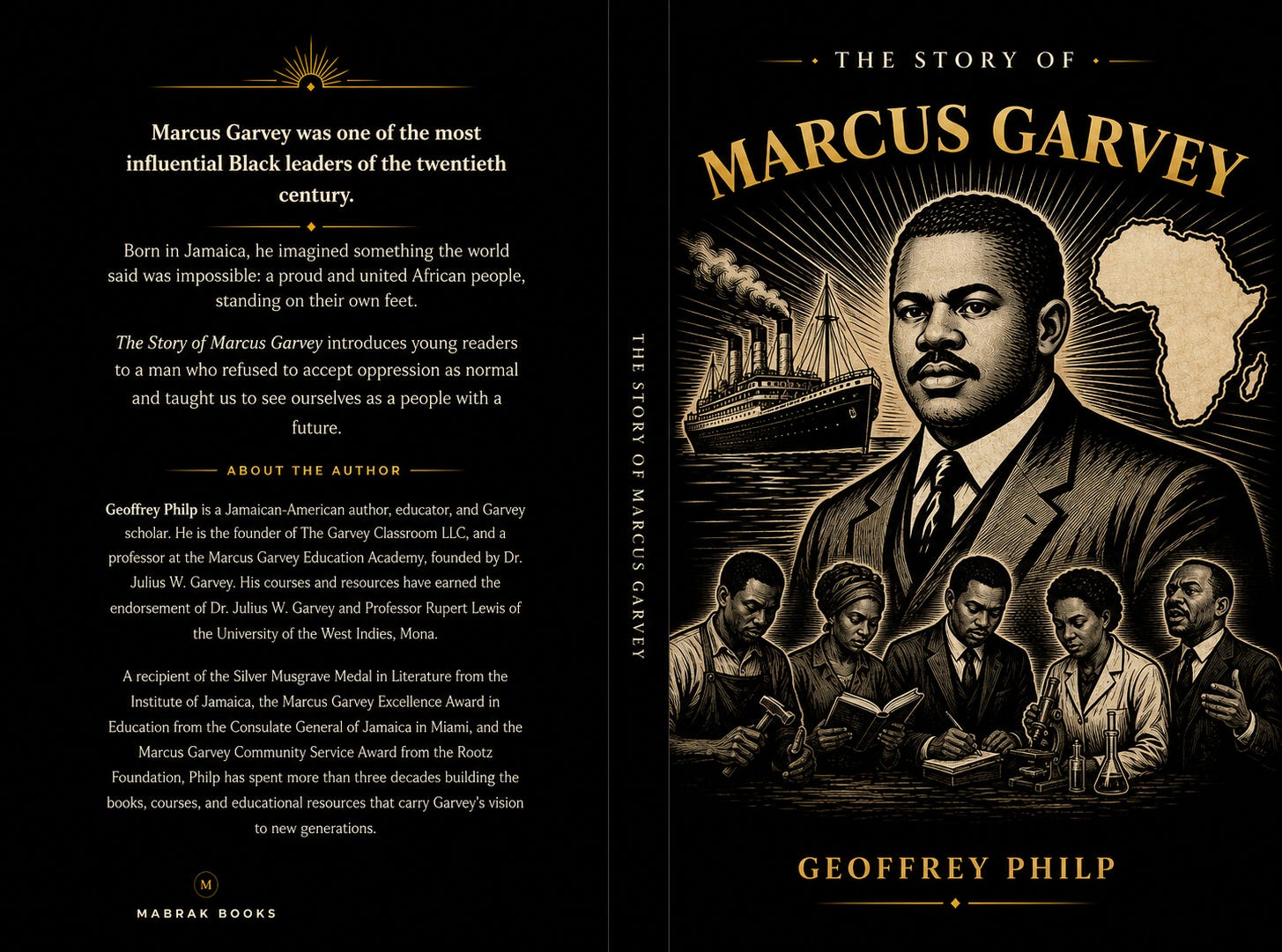
That child will close it and start asking about their own life, about what they are reading, who they are learning from, and what they do the week everything goes wrong. The Story of Marcus Garvey is out now in paperback: The Garvey Classroom transforms the life and philosophy of Marcus Garvey into a practical method for helping Black children read closely, think independently, judge evidence, imagine boldly, and build with purpose.
The Story of Marcus Garvey is my gift to our children. Support the mission of The Garvey Classroom to help Black children grow into confident, conscious, and capable young people who know who they are, think for themselves, and live lives of purpose.
Get full access to The Garvey Classroom at geoffreyphilp.substack.com/subscribe
Podcast news, creator spotlights & picks
Comments (0)
No comments yet.