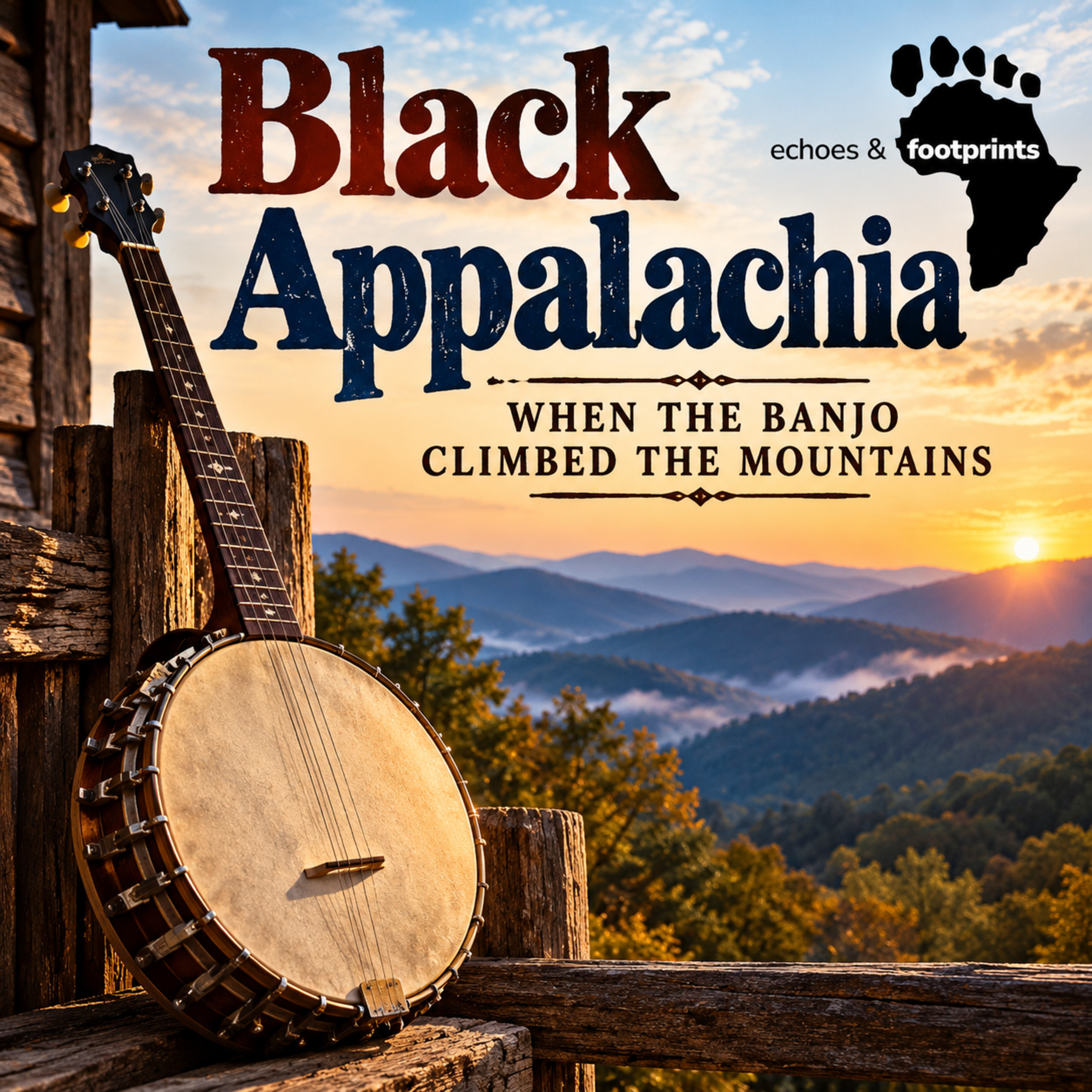
The banjo may sound inseparable from Appalachia, but its story began an ocean away. In this Echoes & Footprints Showcase, we trace the instrument’s journey from its West African relatives through the Caribbean and American South and into the Appalachian Mountains.
Along the way, African musical traditions met European fiddle tunes, ballads, and mountain communities, helping shape a distinctly American sound. We explore the often-overlooked contributions of Black Appalachians and musicians such as Arnold Shultz, Lesley Riddle, and DeFord Bailey—and the musical conversations that helped lay the groundwork for bluegrass.
The mountains didn’t create the banjo. They welcomed it.
The Beat remembers. The Beat is the History.
References Conway, C. (1995). African banjo echoes in Appalachia: A study of folk traditions .
University of Tennessee Press. Dubois, L. (2016).
The banjo: America’s African instrument . Belknap Press of Harvard University Press.
Foster, P. E. (2003).
Black Appalachian music in the mountains and beyond . Smithsonian Folklife Festival.
Smithsonian Folklife Festival Library of Congress. (n.d.). African-American banjo music: Resources in the American Folklife Center .
Library of Congress research guide Smithsonian Center for Folklife and Cultural Heritage. (n.d.). Black musicians’ quest to return the banjo to its African roots .
Smithsonian Folklife Smithsonian Institution. (n.d.). Banjos at the Smithsonian .
Smithsonian Institution Winans, R. B. (Ed.). (2018).
Banjo roots and branches . University of Illinois Press.
Podcast news, creator spotlights & picks
Comments (0)
No comments yet.